Have you ever looked up at the Moon and wondered why it seems to change shape every night?
One evening it's a thin crescent. A week later it's a bright half moon, and before long it becomes a spectacular full moon illuminating the night sky.
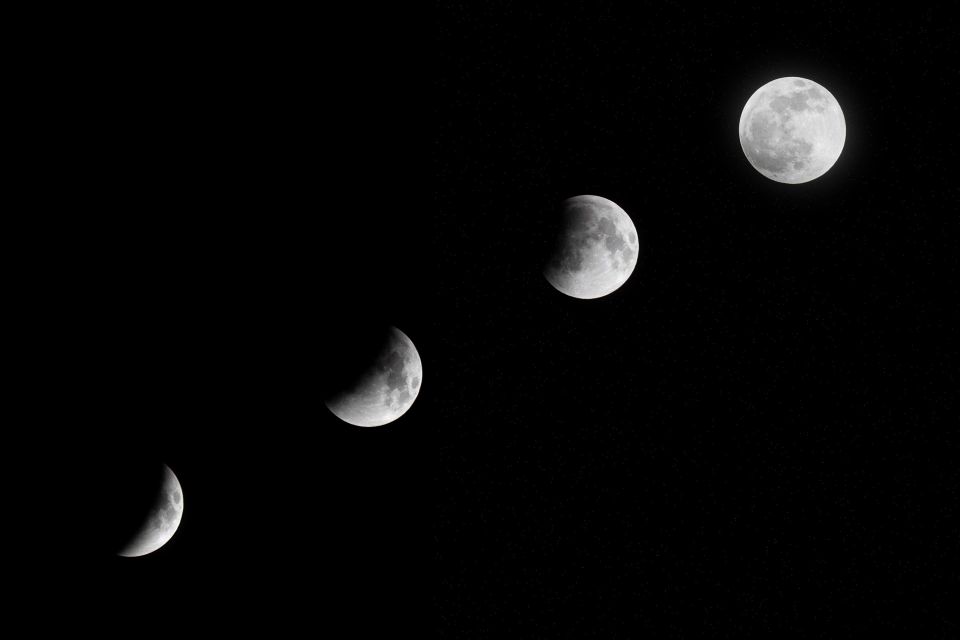
Many people assume Earth's shadow causes these changes, but that's actually a common misconception.
The changing appearance of the Moon is caused by its position relative to the Earth and the Sun, not by Earth's shadow.
Understanding Moon Phases
The Moon doesn't produce its own light. Instead, it reflects sunlight.
As the Moon orbits Earth approximately every 29.5 days, we see different portions of its sunlit surface.
This creates the familiar lunar phases:
🌑 New Moon
The Moon is positioned between the Earth and the Sun. The illuminated side faces away from us, making the Moon nearly invisible.
🌒 Waxing Crescent
A small sliver of the Moon becomes visible as it begins moving eastward in its orbit.
🌓 First Quarter
Half of the Moon appears illuminated. Despite the name, the Moon has completed about one-quarter of its orbit around Earth.
🌔 Waxing Gibbous
More than half of the Moon is illuminated as it approaches the Full Moon.
🌕 Full Moon
Earth sits between the Sun and the Moon, allowing us to see the Moon's fully illuminated face.
🌖 Waning Gibbous
After the Full Moon, the illuminated portion begins to decrease.
🌗 Last Quarter
Again, half of the Moon appears illuminated, but this time the opposite half is visible.
🌘 Waning Crescent
Only a thin crescent remains before the cycle begins again.
Does Earth's Shadow Cause Moon Phases?
No.
Earth's shadow only falls on the Moon during a lunar eclipse, which happens only a few times each year.
During normal lunar phases, the Moon is simply reflecting different amounts of sunlight as viewed from Earth.
Best Time to Observe the Moon
One of the best times to observe the Moon through a telescope or binoculars is during its First Quarter or Last Quarter phases.
Why?
The shadows cast along the line separating day and night on the Moon, called the terminator, create incredible contrast, making mountains, craters, and valleys appear especially detailed.
Many astronomers consider these phases even more impressive than the Full Moon.
Fun Fact
Did you know the same side of the Moon always faces Earth?
That's because the Moon rotates on its axis at the same rate it orbits our planet, a phenomenon known as tidal locking.
Although we often refer to the "dark side" of the Moon, every part of the Moon receives sunlight at different times during its orbit.